The A.A. Milne Collection: Original Pooh Bear & Christopher Robin Stories

A A Milne

Author

Collector's Guide

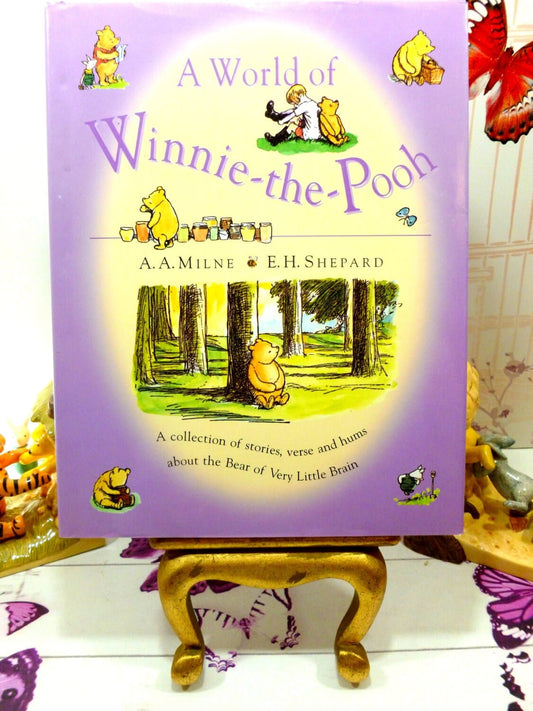
Alan Alexander Milne (1882–1956) remains one of Britain’s most iconic authors. While established as a talented playwright and Punch contributor, his creation of the "Bear of Little Brain"—Winnie-the-Pooh—secured his place in children’s literature history. Influenced by his son Christopher Robin and the nursery world of Cotchford Farm, Milne’s stories, brought to life by E.H. Shepard’s illustrations, celebrate the timeless philosophy of childhood innocence and friendship.
🪶 In their own words
"My mother and I were in the drawing room at Cotchford. The door opened and my father came in. 'Have you finished it?' 'I have.' 'May we hear it?' My father settled himself in his chair. 'Well,' he said, 'we've had a story about the snow, and one about the rain, and one about the mist. So I thought we ought to have one about the wind. And here it is. It's called: 'In Which Piglet Does a Very Grand Thing.' 'Halfway between Pooh's house and Piglet's house was a Thoughtful Spot...' My mother and I, side by side on the sofa, settled ourselves comfortably, happily, excitedly, to listen."

Christopher Milne, The Enchanted Places, 1974
— A A Milne
Kittys Tales Icon

Curated for you

A A Milne Featured

Research & Curation Notes

Alan Alexander Milne, Born on January 18, 1882, in London, England, best known as A.A. Milne, is one of our most iconic British authors. With his creation of the very much loved 'Bear of little brain', Winnie The Pooh, he created one of children's literature's most enduring characters. Milne's creative imagination and literary talent brought to life not only Winnie the Pooh but a beloved collection of whimsical characters that have amused and enchanted generations of readers.

Milne's early life was influenced by his father, John Vine Milne, who was the headmaster of a small private school. He was an intelligent child who won a scholarship to Westminster school when he was 11 years old. Growing up in a stimulating academic environment, young Alan developed a love for storytelling and imaginative play. Milne's work as a playwright and children's author was influenced by his early exposure to education.

Milne's educational journey led to Trinity College, Cambridge, where he studied mathematics. However, his passion for writing took precedence over his academic pursuits, and he became actively involved in various literary and humorous publications. His witty and insightful contributions to Punch magazine gained him recognition and established him as a talented writer and also introduced him to E.H. Shepard the talented illustrator who brought to life Pooh Bear and all his friends with his charming illustrations of Milne's books.

In 1913, claiming the reason that: 'She laughed at my jokes' Milne married Dorothy "Daphne" de Sélincourt. When war broke out his wife encouraged him to write a play for his regiment to try and escape the horror of war. This play seemed better suited to being a children's book and was published in 1917 as 'Once Upon a Time'. The couple welcomed their son, Christopher Robin Milne, in 1920. The comforting nursery world of Christopher Robin, his bond with his nanny and his soft toys would become the inspiration for some of Milne's most iconic characters. Milne's deep bond with his son and their shared adventures in the Hundred Acre Wood would shape the course of his writing career. One of Milne's most famous poems 'Vespers', was inspired by watching Christopher Robin's bowed head whilst being taught to say his prayers by his nanny.

Milne joked with his wife that she could keep any money this sweet poem brought in and she sent it off to 'Vanity Fair' in New York who paid $50 to publish it in January 1923. Later in life he joked it was one of the most expensive presents he had given! In 1924 his collection of poems, 'When We Were Very Young', illustrated by Ernest H. Shepard, the friend of Milne's from 'Punch', was published to much success.

It was in 1926 that Milne introduced the world to the enchanting world of Winnie-the-Pooh based upon the the adventures of Christopher Robin, his toys and their amusements around the countryside near their home of Cotchford Farm, East Sussex.

A.A. Milne passed away on January 31, 1956, leaving behind a rich literary legacy and characters so very much loved that they have become part of history. He continues to inspire and captivate readers of all ages and his books remain timeless classics, cherished for their endearing characters, heartfelt storytelling, and enduring messages of love and friendship. Through his lovable bear character Winnie the Pooh, A.A. Milne will always hold a special place in the hearts of children and adults alike, reminding us of the timeless magic found within the pages of a book.

The lovable bear Winnie the Pooh, and his friends, including Piglet, Tigger, Eeyore, and Rabbit, captured the hearts of readers of all ages. Milne's stories, set in the idyllic Hundred Acre Wood, offered a gentle and whimsical portrayal of childhood innocence, the childish ability to create fun, and the endearing joys of friendship.

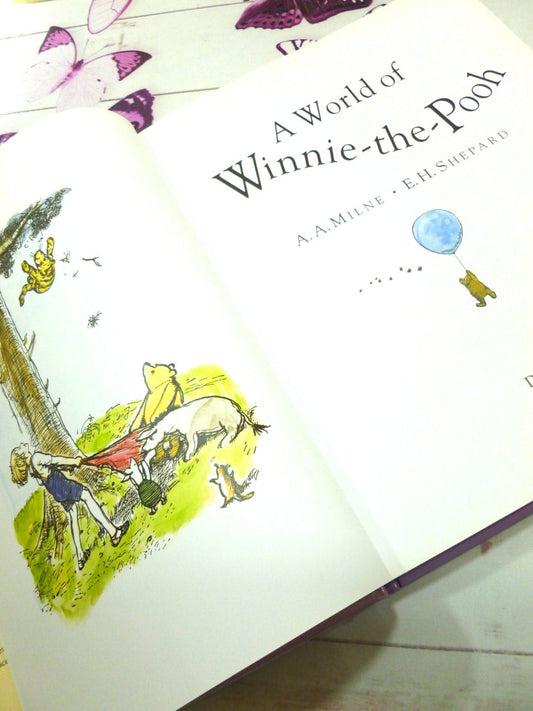
Milne's storytelling prowess was further enhanced by the captivating illustrations of E.H. Shepard, which brought the characters to life with their distinctive charm. The Winnie-the-Pooh books, including "Winnie-the-Pooh" (1926) and "The House at Pooh Corner" (1928), became instant classics, cherished by both children and adults alike.

The phenomenal success of Winnie-the-Pooh propelled Milne into literary stardom, but it also created a complicated relationship between the author and his son, Christopher Robin. As the real-life inspiration behind the character of Christopher Robin, the young boy faced public attention and intrusion into his personal life. This strained the father-son relationship, as Milne's works overshadowed Christopher Robin's own identity. Nevertheless, the stories and characters remained beloved by readers worldwide and Winnie the Pooh has become an icon of early childhood, from nursery decoration and toys to the very first bedtime story told, generations of children have grown up with the sweet philosophy of this grounded little character who can always bring a smile of joy to a child when they hear of his escapades.

Despite being primarily known for his children's literature, Milne also explored various other genres. He wrote several plays, including the successful "Toad of Toad Hall" (1929), an adaptation of Kenneth Grahame's "The Wind in the Willows." However, Milne's enduring legacy and lasting impact lie in his enchanting children's stories, which continue to capture the imagination of young readers.

A.A. Milne's significance to children's literature goes beyond the creation of beloved characters. His stories celebrated the simplicity and wonder of childhood, encouraging readers to embrace imagination and find joy in the small moments of life. Even the amusingly pessimistic character Eeyore had his own philosophical way of making do with his lot in life, with or without a tail, thereby teaching a valuable lesson. Milne's works emphasized the power of friendship, kindness, and the importance of nature, resonating with readers of all generations. When Winnie gets stuck in the rabbit hole because he ate too much honey, all his friends rally round to help, just the way friendship should be.

Still today Milne's books are loved all over the world, translated into numerous languages and adapted into various media, including films, television series, and stage productions. The endearing characters he created, particularly Winnie-the-Pooh, have become cultural icons, symbolizing the innocence and purity of childhood.
From the Researcher's Desk

A.A. Milne: A Specialist Reading List

Biographies & Family History

  • Milne, C.R. (1974) The Enchanted Places. London: Eyre Methuen.The first of Christopher Robin Milne’s autobiographies. It offers a poignant, firsthand account of growing up as the 'real' Christopher Robin and the reality behind the nursery stories.
  • Milne, C.R. (1979) The Path Through the Trees. London: Eyre Methuen.A follow-up focusing on Christopher’s adult life, his attempts to find his own identity, and his eventual reconciliation with his father’s fame.
  • Thwaite, A. (1990) A.A. Milne: His Life. London: Faber & Faber.The definitive, Whitbread Prize-winning biography. Thwaite explores the 'complex and sometimes difficult' man behind the whimsical stories with unparalleled detail.

Artistic & Illustrative History

  • Campbell, P. (2000) E.H. Shepard: The Man Who Drew Pooh. London: Methuen.An essential look at the collaboration between Milne and Shepard. This volume provides context for the sketches that defined the 'Classic Pooh' aesthetic.
  • Sibley, B. (2001) The Pooh Book of Quotations. London: Methuen.While a collection of quotes, Sibley’s annotations provide excellent context on the 'sweet philosophy' that permeates Milne's writing.

Critical & Bibliographic Studies

  • Crews, F.C. (1963) The Pooh Perplex. New York: Dutton.A satirical but brilliant collection of 'academic' essays on Pooh. It’s a must-read for those interested in how Milne’s work became a subject of serious literary criticism.
  • Haring-Smith, W. (1982) A.A. Milne: A Critical Bibliography. New York: Garland Publishing.The 'gold standard' for collectors. It provides a technical breakdown of editions and is the primary tool for verifying rare printings.

Select Bibliography

A.A. Milne: A Comprehensive Bibliography

Children’s Literature & Poetry

  • Milne, A.A. (1924) When We Were Very Young. Illustrated by E.H. Shepard. London: Methuen & Co.The foundational collection of 44 poems that introduced the world to the "Christopher Robin" style.
  • Milne, A.A. (1926) Winnie-the-Pooh. Illustrated by E.H. Shepard. London: Methuen & Co.The first volume of stories featuring the residents of the Hundred Acre Wood.
  • Milne, A.A. (1927) Now We Are Six. Illustrated by E.H. Shepard. London: Methuen & Co.The second poetry collection, featuring iconic verses such as 'Sneezles' and 'The End'.
  • Milne, A.A. (1928) The House at Pooh Corner. Illustrated by E.H. Shepard. London: Methuen & Co.The final narrative volume, notable for the first appearance of Tigger and the 'Poohsticks' game.
  • Milne, A.A. (1929) The Christopher Robin Story Book. London: Methuen & Co.A curated selection of stories and verses chosen by Milne himself for his young audience.


While Milne provided the words, the 'Classic Pooh' aesthetic was defined by the line drawings of E.H. Shepard. Collectors often distinguish between these original Shepard editions and later adaptations."

Fiction & Detective Novels

  • Milne, A.A. (1921) Mr. Pim Passes By. London: Hodder and Stoughton.A prose adaptation of his own successful 1919 stage comedy.
  • Milne, A.A. (1922) The Red House Mystery. London: Methuen & Co.A cornerstone of 'Golden Age' detective fiction, often cited as one of the best locked-room mysteries.
  • Milne, A.A. (1931) Two People. London: Methuen & Co.A gentle, semi-autobiographical novel exploring the quiet complexities of a happy marriage.
  • Milne, A.A. (1946) Chloe Marr. London: Methuen & Co.A sophisticated later novel examining the life of a charismatic socialite through the eyes of others.

Essays, Humour & Autobiography

  • Milne, A.A. (1905) Lovers in London. London: Alston Rivers.Milne’s debut publication, a collection of short sketches reflecting early 20th-century London life.
  • Milne, A.A. (1910) The Day's Play. London: Methuen & Co.A definitive collection of his early 'Punch' magazine contributions.
  • Milne, A.A. (1921) The Sunny Side. London: Methuen & Co.A blend of poems and essays written for an adult audience, showcasing his trademark wit.
  • Milne, A.A. (1939) It's Too Late Now: The Autobiography of a Writer. London: Methuen & Co.An essential primary source for understanding his complex relationship with his most famous creation.

Drama & Screen

  • Milne, A.A. (1917) Once Upon a Time. London: Hodder & Stoughton.A fairytale play written during his military service, later serving as a bridge to his children's work.
  • Milne, A.A. (1917) Wurzel-Flummery. London: Samuel French.A witty comedy of manners involving a ridiculous name and a large inheritance.
  • Milne, A.A. (1922) The Dover Road. London: Samuel French.One of his most successful stage comedies, later adapted for film.
  • Milne, A.A. (1929) Toad of Toad Hall. London: Methuen & Co.The enduring stage adaptation of Kenneth Grahame’s 'The Wind in the Willows'.
  • Milne, A.A. (1936) Miss Elizabeth Bennet. London: Methuen & Co.A dramatic retelling of Jane Austen’s 'Pride and Prejudice'.

Non-Fiction & Pacifist Essays

  • Milne, A.A. (1934) Peace with Honour. London: Methuen & Co.A passionate plea for pacifism that sparked significant national debate.
  • Milne, A.A. (1940) War with Honour. London: Macmillan & Co.Milne’s nuanced follow-up, explaining his support for the war effort against Germany.

Book Highlights

Chosen with care from our
A A Milne collection