Beatrix Potter
❧ Collector's Guide
Born into the hushed, velvet-draped world of a wealthy Victorian London home, Helen Beatrix Potter was destined for a life of "cosseted" society. Yet, beneath the schoolroom lessons lay the heart of a rebel and a scientist. Finding companionship in the "flora and fauna" of the Scottish Highlands and the English Lake District, Beatrix transformed her sheltered upbringing into a world of exquisite watercolours and "charming vignettes." From a humble letter sent to cheer a sick child grew the global phenomenon of The Tale of Peter Rabbit. Our Collector’s Archive celebrates the woman who defied social convention to become a prize-winning sheep farmer and a pioneer of land conservation, forever preserving the "shifting sands" of the countryside she so dearly loved.
"I wonder if your pussy cat has learned to catch mice yet. I think it would rather lap milk, it is too fine to work like a common cat."
Extracts from Beatrix Potter's letters to Noel.
Curated for you
-
The Tale of Jemima Puddle Duck Beatrix Potter Vintage Children's Book First Centenary Edition
Vendor:Kittys TalesRegular price £78.00 GBPRegular priceSale price £78.00 GBP -
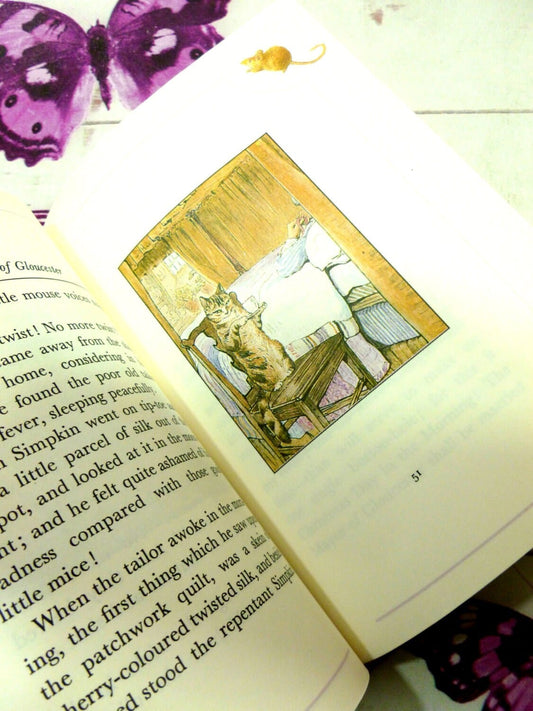
The Tailor of Gloucester Beatrix Potter Vintage Children's Book Bloomsbury 1993
Vendor:Kittys TalesRegular price £8.00 GBPRegular priceSale price £8.00 GBP -
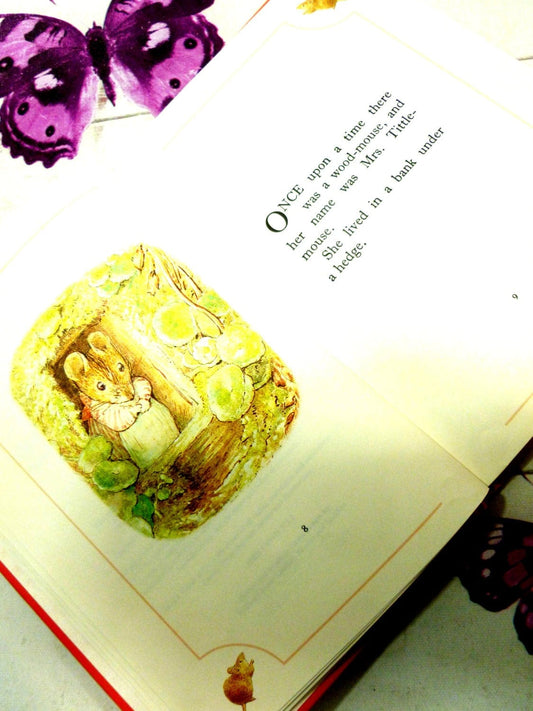
The Tale of Mrs TittleMouse Beatrix Potter Vintage Childrens Book Bloomsbury 1993
Vendor:Kittys TalesRegular price £8.00 GBPRegular priceSale price £8.00 GBP
❧ Research & Curation Notes
BEATRIX POTTER: Her Life
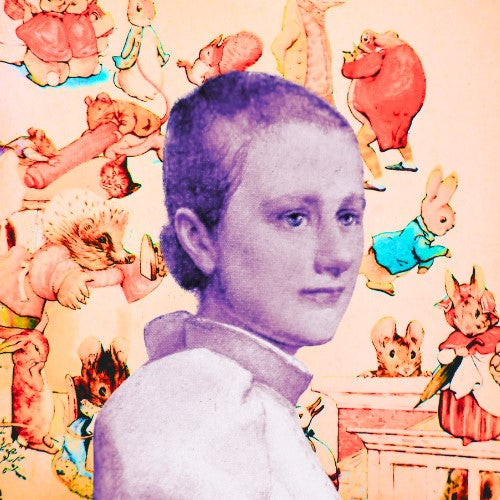
In the year 1866 a baby girl was born to a distinguished family living in London. It was the time of Queen Victoria and this family were a typical upper class Victorian family. They lived in a tall, elegant house. The baby was surrounded by servants and all the advantages of a wealthy home. Her father, Rupert Potter was an established and well respected Lawyer, along with his wife Helen they lived the life expected of a well to do family in London in the 19th Century.
The child named after her mother Helen, was brought into a life where she would be cossetted until she found a suitable husband to marry. The fate of this highly intelligent, independent spirited little girl would however, take a somewhat different direction and she was destined to become one of the most famous female writers and illustrators of the 20th Century.
The first thing to note is we do not know her as Helen instead Beatrix Potter is the name that is now famous worldwide. It is not apparent why she became known as Beatrix, perhaps the girl preferred this less common place name or perhaps it was the choice of her parents. Beatrix had a brother called Bertram so maybe it was simply that Beatrix and Bertram had a nice ring to it. Beatrix was great friends with her brother, in fact in her sheltered life he was the only really young companionship she had. As was normal for many young girls in the Victorian Era Beatrix was taught her lessons at home by a Governess. She was an apt and willing pupil, spending most of her time in the schoolroom. Beatrix and her brother amused themselves duringt heir secluded upbringing with their love and fascination regarding the flora and fauna of the natural world.
Beatrix especially loved to paint and sketch animals and the natural world. From her earliest days she demonstrated a keen talent for watercolour painting. Perhaps she was encouraged and inspired by her father in this suitable occupation for a young woman as it is known that he took her to visit the famous artist Millais one of her father’s many society friends. Perhaps this experience sowed the seed of an idea in Beatrix that she could make use of her artistic talents. She spent all her free time making sketches and studies of everything she could find in the natural world and loved the countryside.
In the summer months the whole family would depart for Scotland. Amusingly, this excursion would also include the latest family pets; even Beatrix’s pets such as Rabbits and Lizards would be boxed and prepared for the long journey to Scotland for the summer holidays a location made popular due to Queen Victoria’s love of the Highlands and her holiday home Balmoral. These extended vacations would often last three months. Whilst Beatrix’s father fished and enjoyed gentlemanly country pursuits Beatrix and Bertram were practically left to make their own enjoyment which they did by exploring the wild landscape.
Around this time it seems Beatrix had formed her first ambitions to be an artist. She kept a coded diary that she wrote her thoughts and passions in and mentioned how she wished to be an artist one day. At the age of sixteen a change in routine had momentous implications for the eventual life of Beatrix. Instead of Scotland for the holidays the family chose to go and stay in a grand castle in the English Lake District. There are a few photographs showing the Potter family at Wray Castle. It is not surprising that Beatrix was enchanted by this experience and when the holiday was over longed to return to the idyllic Lake District.
For a young woman with such an energy of mind and spirit she yearned for experience and activities that stimulated her intelligence further. She became interested in Science and started making naturalistic studies of plants, insects and fungi. There is an exquisite watercolour that Beatrix made around this time of Mushrooms. She submitted papers to the scientific world but they were dismissed leaving Beatrix feeling very deflated. To make matters worse it was not deemed respectable in this staid Victorian era for a respectable young woman to have any real employment. She was simply expected to become a wife and mother.
✥ The Secret Code: Beatrix wrote a private diary in a code so complex it wasn't deciphered until decades after her death.
✥ Scientific Snub: Her detailed studies of mushrooms and fungi were ignored by the male-dominated scientific world of the 1890s.
BEATRIX POTTER: Her Work
After her initial disappointment with her scientific endeavours Beatrix fell back upon her first love of painting and amused herself by painting charming vignettes of little dressed animals based upon the pets she had kept at home. One of the pets she was most fond of, Benjamin, her bunny, modelled for many images of cute rabbits. Some of these little paintings were so good that having a company that made greetings cards they decided to use some of Beatrix’s art and so she made her first commission.
The next defining moment was when a friend of Beatrix’s, a little boy called Noel became ill, Beatrix wrote him a long humorous letter beautifully illustrated with her exquisite little rabbit drawings to cheer him up. By now Beatrix was a young woman eager to make her way in the world and break free of the slightly claustrophobic situation she was in at home. Times were changing, not as dramatically as within the first quarter of the 20th century but there were women in the 1890’s who began to work and gain a little independence for themselves and Beatrix will not have been unaware of the shifting sands in the social structure.
In 1902 Beatrix realised that the charming letter she had sent Noel had potential as children’s story. She determined to make it into a little book for children and set about privately printing the story producing a very few copies in simple card covers with plain black and white illustrations. Eventually the publishing house Frederick Warne & Co., despite having previously rejected the little book agreed to publish it if Beatrix improved upon the illustrations by completing them in colour.
This little book, The Tale of Peter Rabbit by Beatrix Potter, first published in 1902 was enchanting to children and instantly became a great success for Beatrix. Empowered by her success Beatrix instantly went on to produce more such tales drawing upon her love of all the charming little animals she surrounded herself with as a child.
During Beatrix’s relationship with the Frederick Warne & Co., publishing house she became romantically involved with Norman Warne and by 1905 they were so much in love they became engaged to be married. Beatrix’s parents were not happy at all about the liaison as they saw Norman Warne as being too commonplace for Beatrix as he was in trade and not a member of the upper eschelons of society. They strongly disputed the match but Beatrix had become a strong young woman and was determined to have her romantic choice. Sadly however determined and strong Beatrix was in defying her parent’s wishes this was not meant to be for her as Norman tragically died before they could ever be wed.
Times had changed for Beatrix, by now she was a woman of substantial means, not completely dependent upon her parents for money. This gave her the freedom to return to the Lake District she loved and buy her first own piece of property there. This little home was the farmhouse Hill Top near Sawrey.
As her life progressed Beatrix became passionately involved with the local countryside community and took an active role farming her land. It was not long before her passion for the countryside and the money she made from her little books encouraged her to buy another farm in her beloved Lake District. She needed some financial advice around her property purchasing and met a kindly gentleman called Mr William Heelis. William and Beatrix formed a strong friendship and this finally blossomed into love. They both shared a great respect of the countryside and were early environmentalists passionate about protecting the beautiful landscape from the damage of industrialisation and development.
Beatrix and William had a very happy marriage with his guidance and support over her investments she continued to buy parcels of land in the Lake District. She became a keen sheep farmer and won many prizes with her flock of Herdwick sheep.
By this time Beatrix had written many children’s stories that we know and love today.Beatrix continued to paint and draw for her own pleasure as long as her eyesight allowed. Despite her tragic first love Beatrix and William had over thirty years of happy and fulfilling married life together. In her later years Beatrix recognised the need for an organisation such as the “National Trust for Places of Historic Interest or Natural Beauty” to protect the landscape and grazing lands that were so critical for the farming communities.
Beatrix had a long and happy life. This shy young woman had forged her own path and along the way created characters that enchanted children for generations and still do today. By the time Beatrix died in 1943 she had acquired thousands of acres of land in the Lake District and surrounding areas. Eventually the National Trust received this land in a bequest from Beatrix, one of the most important bequests the National Trust has ever received. Today it is still possible to visit Beatrix’s home Hill Top in Sawrey, or visit William’s offices and see a gallery of Beatrix’s original exquisite watercolour paintings.
We don’t need to visit Sawrey to enjoy it though as still today in Beatrix’s children’s books we can see snippets of her life at the farm in the adorable illustrations she made for her little books. There is even a humble self portrait in her early editions. Since Beatrix many illustrators have shown tiny animals dressed and going about their daily lives as if they were really people just like us but none have truly done it quite so charmingly or quite so convincingly as Beatrix did. And that is why we still love her books today.
❧ From the Researcher's Desk
Annotated Bibliography: Beatrix Potter
Lane, M. (1946) The Tale of Beatrix Potter: A Biography. London: Frederick Warne & Co.
Note: The first major biography, published by her original house. It provides the foundational narrative of her secluded London life and her tragic first engagement to Norman Warne.
Potter, B. (1966) The Journal of Beatrix Potter from 1881 to 1897. Transcribed by L. Linder. London: Frederick Warne & Co.
Note: Transcribed from her secret "coded diary," this is an essential primary source that reveals her sharp intelligence, her frustrations with the Victorian era, and her early ambitions to be an artist and scientist.
Linder, L. (1971) A History of the Writings of Beatrix Potter. London: Frederick Warne & Co.
Note: A "sturdy" reference for any collector, this volume meticulously documents the publication history of her little books, including the privately printed first editions that collectors covet.
Taylor, J. (1986) Beatrix Potter: Artist, Storyteller and Countrywoman. London: Frederick Warne & Co.
Note: This work highlights her later life at Hill Top and her marriage to William Heelis, focusing on her transition from an urban artist to a dedicated Herdwick sheep farmer and conservationist.
Lear, L. (2007) Beatrix Potter: A Life in Nature. London: Allen Lane.
Note: A definitive modern biography that explores her dismissed scientific papers on fungi and her pivotal role in the early days of the National Trust.
❧ Select Bibliography
The Tale of Peter Rabbit was initially privately printed in 1901 by Beatrix.
Beatrix Potter's Tales: Publication Timeline
1902: The Tale of Peter Rabbit
1903: The Tale of Squirrel Nutkin
1903: The Tailor of Gloucester
1904: The Tale of Benjamin Bunny
1904: The Tale of Two Bad Mice
1905: The Tale of Mrs. Tiggy-Winkle
1905: The Tale of the Pie and the Patty-Pan
1906: The Tale of Mr. Jeremy Fisher
1906: The Story of a Fierce Bad Rabbit
1906: The Story of Miss Moppet
1907: The Tale of Tom Kitten
1908: The Tale of Jemima Puddle-Duck
1908: The Tale of Samuel Whiskers or,
The Roly-Poly Pudding
1909: The Tale of the Flopsy Bunnies
1909: The Tale of Ginger and Pickles
1910: The Tale of Mrs. Tittlemouse
1911: The Tale of Timmy Tiptoes
1912: The Tale of Mr. Tod
1913: The Tale of Pigling Bland
1917: Appley Dapply's Nursery Rhymes
1918: The Tale of Johnny Town-Mouse
1922: Cecily Parsley's Nursery Rhymes
1930: The Tale of Little Pig Robinson
Additional Books Published
1911: Peter Rabbit's Painting Book
1917: Tom Kitten's Painting Book
1925: Jemima Puddle-Duck's Painting Book
1928: Peter Rabbit's Almanac for 1929
1929: The Fairy Caravan
1932: Sister Anne (illustrated by Katharine Sturges)
1944: Wag-by-Wall (decorations by J. J. Lankes)
1955: The Tale of the Faithful Dove (illustrated by Marie Angel) (Reprint 1970)
1906: The Sly Old Cat (first published 1971)
1973: The Tale of Tuppenny (illustrated by Marie Angel)
2016: The Tale of Kitty-in-Boots (Illustrated by Quentin Blake.)
2019: Red Riding Hood (Illustrated by Helen Oxenbury.)
* Beatrix also contributed illustrations towards various other publications as well as the enchanting little booklet 'A Happy Pair'.
For further research The Beatrix Potter Society is dedicated to furthering knowledge about Beatrix Potter's life and works.
Book Highlights
Chosen with care from our
Beatrix Potter collection
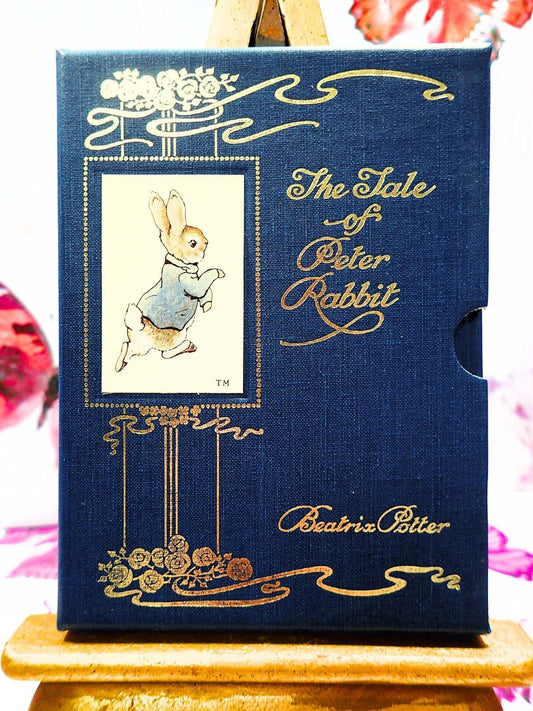
The Tale of Peter Rabbit Beatrix Potter Vintage Children's Book First Centenary Edition Deluxe
Beatrix Potter Books
Our adorable vintage Beatrix Potter books include all her classic tales such...
Related Collections
Curated archives and rare editions
- Choosing a selection results in a full page refresh.
- Opens in a new window.